Meditation
SHAPESHIFTING - Dorothea Tanning, Elsa Thoresen, Isabelle Zetterström & Jenny Palén
fredag 6 november 2026, 18:00Stockholm, Ulrikagatan 13, 115 23 Stockholm, Sweden
Arrangeras av
Belenius
Om detta evenemang
SHAPESHIFTING
Dorothea Tanning
Elsa Thoresen
Isabelle Zetterström
Jenny Palén
Co-curated by Roland-Philippe Kretzschmar
A form becomes recognisable through the associations it permits. A contour suggests a body; a surface evokes a landscape; an organic structure appears to belong to several possible organisms. When these associations coexist without resolving into a stable identity, recognition becomes uncertain. Shapeshifting brings together four artists whose practices explore the imaginative and psychological possibilities of this uncertainty.
Across the work of Dorothea Tanning, Elsa Thoresen, Isabelle Zetterström, Jenny Palén, metamorphosis operates through the construction of images, their material realisation and the meanings they acquire. The exhibition approaches Surrealism through this capacity for transformation, examining how its historical concerns with dreams and unconscious association continue to inform questions of perception, identity and artistic production.
Gaston Bachelard’s account of imagination offers a philosophical framework for this enquiry. In Air and Dreams (1943), he emphasises the capacity of imagination to transform the images supplied by perception, releasing them from their initial identities and bringing them into unexpected relationships. Developed through his study of literary imagination, this argument allows metamorphosis to be understood as a principle of imaginative activity. An image remains open through its capacity to generate further associations. Applied to the exhibition, Bachelard’s thinking directs attention to the movement through which a form becomes available to several readings.
In Dorothea Tanning’s painting, transformation extends into the organisation of pictorial space. From the mid-1950s, her increasingly fragmented compositions complicate the distinction between figures and their surroundings. Forms merge and interrupt one another, making the act of identification provisional. Tanning described wanting to lead the eye into spaces that simultaneously concealed, revealed and transformed. Painting becomes a means of sustaining this tension within visibility itself. Her wider practice, encompassing soft sculpture and writing, develops the relationship between bodily suggestion, material presence and imaginative association through different forms of expression.
Elsa Thoresen approaches transformation through the imaginative reorganisation of the natural world. An important participant in Scandinavian Surrealism, she developed a visual language informed by organic structures, including driftwood, and fantastic landscapes. Her later movement towards biomorphic abstraction loosened the relationship between these structures and identifiable objects while retaining their associations with living matter. Within the exhibition, this development supports a reading of abstraction as a continuation of Surrealist enquiry. Transformation persists as recognisable subjects recede, becoming embedded in the relationships between shapes and in their capacity to suggest unfamiliar forms of life.
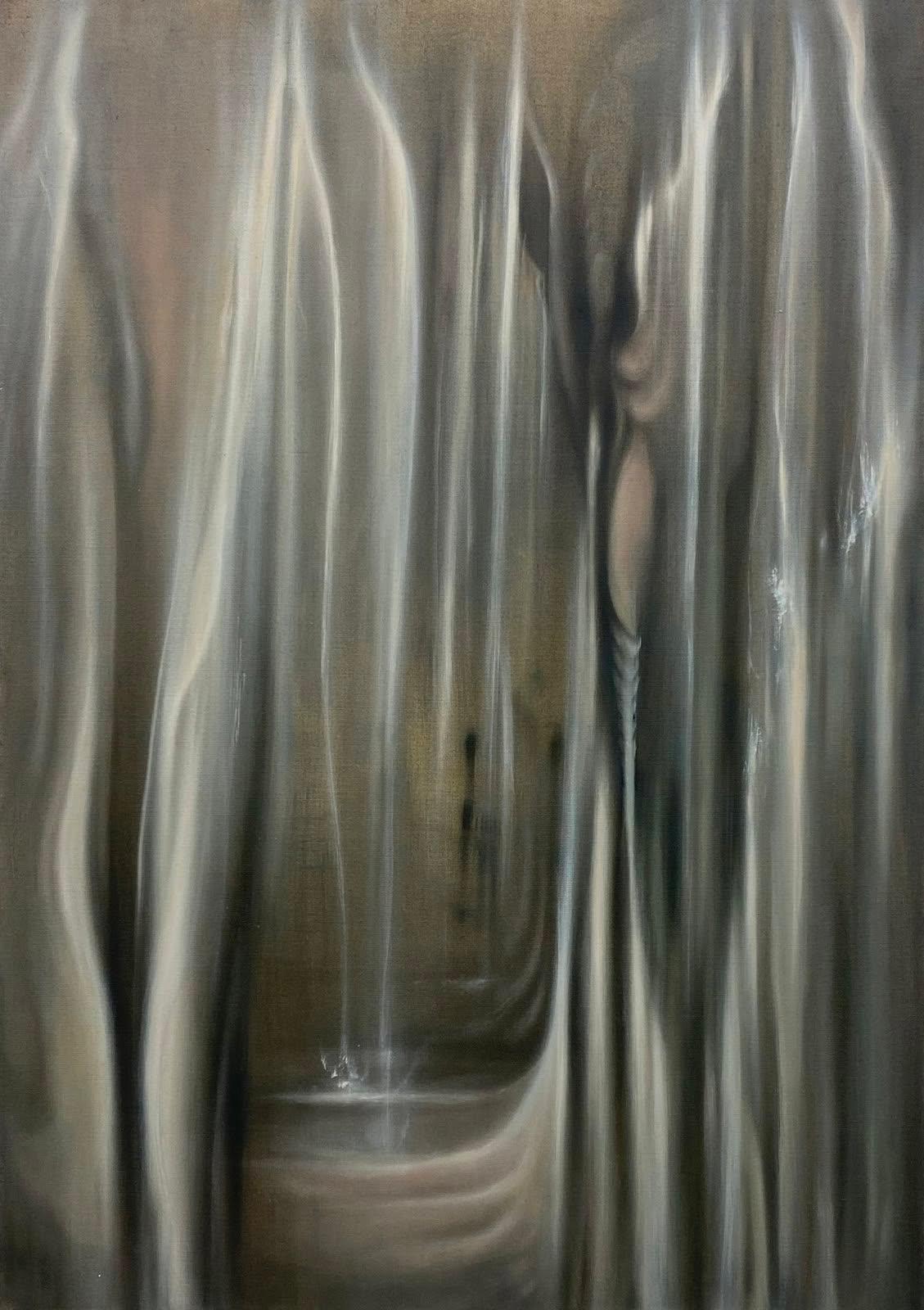
For Isabelle Zetterström, the instability of form is closely connected to the changing constitution of the self. Her imagined landscapes contain growths whose associations move between anatomy, vegetation and unfamiliar organisms. In the paintings developed for this exhibition, light and shadow articulate the relationships between outward presentation, idealised identity and experiences that remain partially concealed. She describes a self in which earlier states continue to act upon the present. Darkness consequently acquires an ambivalent function: it can evoke discomfort and fear while also suggesting protection. The paintings give perceptible form to these conflicting functions, allowing emotional experience to emerge before it becomes fully available to explanation.
Jenny Palén’s account of her practice likewise places understanding within an unfolding process. An image or sensation may initiate a work whose significance becomes apparent only after its completion. Her movement between painting, sculpture, installation and film follows the developing demands of an idea. Existing works remain active within this process: a shape, colour or object encountered again in the studio can return in a different configuration. Dreams and meditation contribute images whose vividness is accompanied by difficulty in retaining them. Transformation therefore operates across materials and through time, as the work acquires meanings that were unavailable at the moment of its production. Humour introduces a further ambiguity, allowing pleasure, absurdity and unease to coexist.
These practices also invite a phenomenological consideration of looking. In Eye and Mind, Maurice Merleau-Ponty situates vision within our bodily participation in the visible world. The perceiving subject belongs to the world being perceived, and painting arises from this involvement. His account provides a way to reconsider the separation between an interior psychological reality and an external environment. Applied here, it suggests that the recognition of bodily, vegetal or spatial forms draws upon our lived experience of inhabiting a body and moving through the world.
The uncertainty encountered in these images consequently concerns the viewer as well as the represented form. Associations develop, compete and change during the act of looking. Shapeshifting names this reciprocal process, in which an image’s resistance to a settled identity exposes the habits through which recognition takes place. The exhibition locates a continuing possibility of Surrealism in that encounter: a form can become perceptible while remaining capable of changing what we understand it to be.
Roland-Philippe Kretzschmar, co-curator
November 2026
Dorothea Tanning (b. 1910) in Galesburg, Illinois, USA. Died 2012 in New York, USA.
American painter and sculptor Dorothea Tanning studied at the Chicago Academy of Fine Arts before moving to New York in 1938, where she became involved in Surrealism. She married Max Ernst in 1946 and associated with Surrealists in exile, including André Breton and Marcel Duchamp. Her work was exhibited by influential galleries Julien Levy and Alexander Iolas, and she participated in Peggy Guggenheim’s pioneering Exhibition by 31 Women in 1943. Tanning soon established herself as a leading figure in post-war American art.
Tanning’s Surrealism is subtle and captivating, turning familiar domestic spaces into strange and dreamlike worlds. Her work slowly blurs the line between reality and fantasy, drawing viewers into scenes that feel both familiar and unsettling. A mix of curiosity, unease, and erotic tension makes her work both mysterious and engaging. Today, she is considered one of the foremost and most distinctive surrealists, with her work represented in museums and collections worldwide.
Combining eroticism and esoteric symbolism, Tanning created deeply personal and enigmatic works that earned critical acclaim. Major institutions, including the Centre Pompidou and the Philadelphia Museum of Art, later dedicated retrospectives to her. After Ernst’s death in 1976, she returned to New York, where she lived until her death on January 31, 2012. Her work was exhibited at Tate Modern in London in 2019.
Elsa Thoresen (b. 1906) in Benson, Minnesota, USA. Died 1994 in Seattle, Washington, USA.
Thoresen was a Surrealist painter who lived and worked in Norway, Denmark, Sweden and the USA. Thoresen studied at Statens håndverks- og kunstindustriskole in Oslo 1924 – 1927, at Statens Kunstakademi in Oslo 1927 – 1930 and at the Académie des Beaux-Arts in Brussels 1928 – 1929. Thoresen lived in Copenhagen between 1935 – 1944. Escaping the Nazi occupation of Denmark in 1944, Thoresen lived and worked in Stockholm and spent her summers in Halmstad. She moved back to the USA in 1953 where she lived until her death.
Thoresen’s work was shown at the Exposition Internationale du Surréalisme in Paris in 1938, organized by surrealist theorist André Breton and possibly the movement’s most important poet Paul Éluard. In 1947 she was the only woman in the Danish group at the International Surrealist Exhibition in the Galerie Maeght in Paris. Thoresen’s later paintings became more abstract, drawing the viewer into the quiet intimate smaller format, to take part of what appears to be almost a choreography of movement of shapes. After her passing, Thoresen’s works have been shown in museum exhibitions in Louisiana, Schirn Kunsthalle, Frankfurt, COBRA Museum voor Moderne Kunst, Amstelveen, Holland, Artipelag, Stockholm, Musée de Montmartre, Paris and Cascadia Art Museum, Edmonds, WA, USA.
Isabelle Zetterström (b. 1995) is an English-Swedish artist, based in London, UK.
Zetterström’s ethereal practice spans painting, works on paper, ceramics, and performance. Her oil paintings and watercolours on paper open portals into ambiguous terrains, while her ceramics serve as artefacts gathered from within these imagined realms. Her atmospheres drift between micro and macro, into deep seas and celestial perspectives; pulsating forms unfurl in tones of blood, merging with volcanic greys, noctilucent pools resemble water, as floating branches shift into veins, awakening an uncanny sense of awe and unease.
Zetterström views painting as a spiritual act, a dance with the subconscious, exposing the soul to unseen forces. Summoning paintings from the abyss, she escapes into them, only to find her own reflection.
Jenny Palén (b. 1982) is an artist and filmworker who lives and work in Stockholm.
She graduated from the Royal Art Institute in Stockholm 2015. Her work consists of installations, video and sculpture. In recent years her practice has been focused on existential and surreal themes addressed though film, performance and scenography. She used to be a graffiti artist, which is evident in her drawing style with characteristic lines and distinct colours. Caracters from images reappears in sculptural works and videos.
Between 2006 – 2011 Jenny Palén co-founded and ran the independent art space Bastard Gallery in Stockholm. Her work has been showed at The Art Academy in Stockholm, Fullersta Gård, National Gallery in Prague and Academy of Fine Arts Vienna. Between 2016 – 2017 Palén has studied acting and is currently developing projects where art and theatre intertwine.
Var det äger rum
Ulrikagatan 13, SE-115 23 Stockholm, Sverige
Stockholm
Stockholm
Ulrikagatan 13, 115 23 Stockholm, Sweden
Bra att veta
Avbokning
Fri avbokning fram till evenemangets starttid.